Baphomet: On a goat-headed idol that was never worshipped, drawn by a man who did not mean the Devil, and the seven-hundred-year game of telephone that turned a word for “Muhammad” into the face of evil.
You know this image. A goat’s head on a human body. Great curling horns. Wings on its back, a torch burning between the horns, one hand raised and one lowered. It is, today, the single most recognizable symbol of the Devil in the Western world: on album covers, in horror films, on the emblem of the Church of Satan.
Its name is Baphomet. And almost everything you have been told about it is wrong.
It is not ancient. It was not worshipped by the Knights Templar. It was not, originally, the Devil at all. The goat-headed figure you are picturing right now was drawn by one man, in one book, in the year 1856. And he did not mean it as Satan.
The real story of Baphomet is a seven-hundred-year game of telephone, and it is one of the clearest examples of the deepest pattern on this channel: symbols do not carry fixed meanings. They carry whatever we pour into them.
A word for Muhammad.
The story starts with the Crusades. The earliest known appearance of the word comes from a letter written in 1098 by a French crusader in the Holy Land, describing his Muslim enemies calling out to “Baphometh.”
He meant Muhammad. “Baphometh,” “Bafometz,” “Baphomet” were European corruptions of “Mahomet,” the Latinized form of the name. Medieval Christians misunderstood Islam. Many wrongly believed Muslims worshipped Muhammad as a god, that Islam was a form of idolatry. It was a profound error; Islam is fiercely monotheistic and forbids exactly that. But the enemy’s god, garbled through Latin and French, came out as something like Baphomet.
So at the very beginning, Baphomet is not a demon and not a goat. It is a slur, a mispronunciation of the name of a prophet a hostile culture did not understand. That word drifted through European languages for two centuries. And then it walked into a torture chamber.
The idol that confessions built.
In 1307, the Knights Templar were arrested and tortured into confessing to monstrous crimes. Among the forced accusations was that they worshipped an idol, a mysterious head. And in some confessions, extracted under agony, that idol was given a name: Baphomet.
Think about what that means. The Templars had fought for generations in the Holy Land. The old word “Baphomet” was floating in the culture, vaguely associated with the mysterious East and forbidden foreign worship. Under torture, with interrogators demanding a confession of idolatry, it is entirely unsurprising that this half-familiar word surfaced and attached itself to an imagined idol.
There was no statue. Investigators searched Templar properties across Europe and found no demonic head, nothing. The descriptions were wildly inconsistent — a head, a cat, a figure with three faces — the incoherence of people inventing details to satisfy a torturer. Still, there is no goat here, no wings, no torch. In 1307, Baphomet is just a name attached to a phantom object. Then the word goes to sleep for five hundred years.
The man who drew the Devil.
Then comes the nineteenth century and a very particular man: Alphonse-Louis Constant, a French deacon who left the path to the priesthood and reinvented himself as a ceremonial magician under the Hebrew-styled pen name Éliphas Lévi.
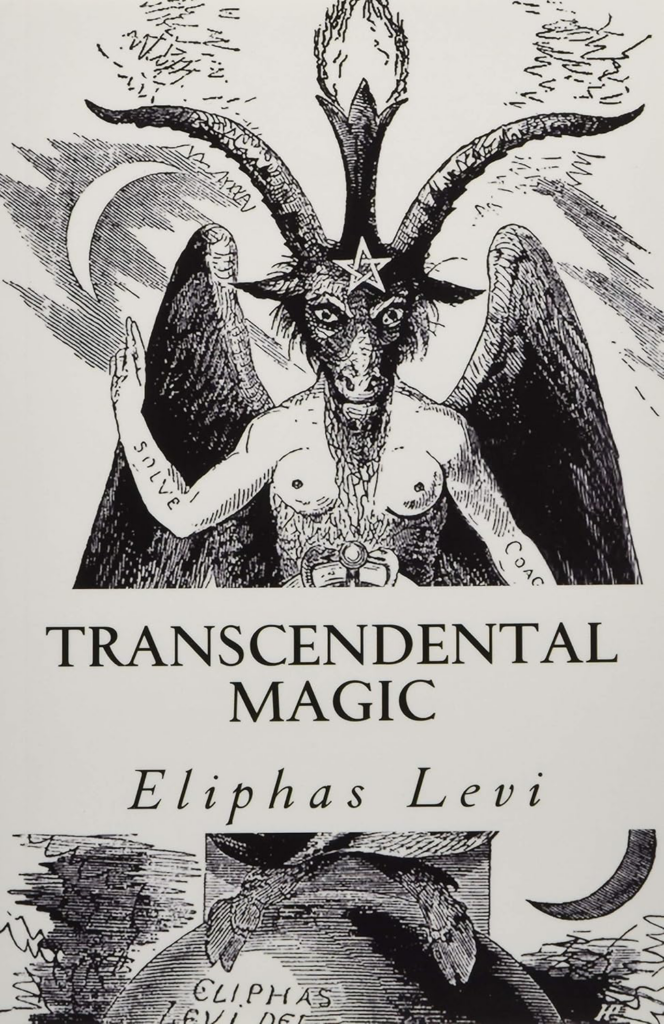
In 1856, in the second volume of his Dogme et Rituel de la Haute Magie, Lévi drew a frontispiece he called the Baphomet of Mendes, or the Sabbatic Goat. This is the image. Every goat-headed Baphomet in the world descends from this one drawing: the horns, the wings, the torch, the raised and lowered arms, the human torso.
But here is what has been almost completely erased. Lévi did not draw the Devil. He was explicit: his Baphomet was a symbol of the union of opposites, the balance of the entire cosmos. Male and female in one body, human and animal, above and below. On its arms he wrote SOLVE and COAGULA — dissolve and bind, the alchemical rhythm of the universe in balance. It was, to him, almost the opposite of evil. It was totality. He took the old, empty, frightening word and gave it a face, but the face was not meant to be Satan’s.
How the symbol became the Devil.
So how did a symbol of cosmic harmony become the most famous face of the Devil? Layer by layer.
First, the image was too easy to misread. A goat-headed figure with horns looked, to an eye trained for centuries to see the Devil in exactly those features, the goat of the witches’ sabbath, like Satan, whatever Lévi intended.
Then the occult tradition ran with it. Lévi’s drawing directly shaped the Devil card in the hugely popular Rider-Waite tarot deck; the designer said so openly. Aleister Crowley embraced Baphomet and deliberately tied it to forbidden knowledge and initiation. And in the late 1960s came the final transformation: the newly founded Church of Satan adopted the goat’s head inside an inverted pentagram as its official emblem, the Sigil of Baphomet. From there it poured into popular culture and eventually into a large statue commissioned by yet another, separate group, the Satanic Temple, as pointed political theater about religious freedom.
Four different groups, four different centuries, four different meanings, all wearing the same borrowed face and all collapsed, in the popular mind, into a single false sentence: “Baphomet, the satanic goat-god worshipped by the Knights Templar.” Not one part of that sentence is true. The Templars never worshipped him. He was not a god. He was not originally satanic. And he was not a goat until 1856.
The image that holds still.
Count the transformations. A mangled attempt to say Muhammad became, under torture, the name of an idol that never existed. It slept for five centuries. It was redrawn as a symbol of cosmic balance its author explicitly said was not the Devil. It was mistaken for the Devil anyway, adopted by occultists, and finally crowned as the official emblem of Satanism.
At every stage, the meaning flipped into something its previous owners never intended. Each generation looked at the inherited word or image and poured into it whatever they already feared or desired, then passed it on, transformed, to the next.
That is the whole engine of this subject, compressed into one word. We think symbols carry fixed meanings. They don’t. They carry whatever we put into them. A thing can mean the enemy’s god, then a phantom idol, then the balance of the universe, then absolute evil, and never once change its shape while doing it. Only we change. The image just holds still and lets us confess ourselves onto it.
The next time you see that goat-headed figure and feel the little shiver of the forbidden, remember what you are actually looking at. Not an ancient demon. A seven-hundred-year-old misunderstanding, wearing a face a Frenchman drew in 1856, meaning whatever the last frightened generation needed it to mean.
This is Conspiracy Explained — a dystopien.de production. Not to debunk. Not to mock. To understand.
Watch the full episode here
Recommended reading:
Massimo Introvigne — Satanism: A Social History
Éliphas Lévi — Transcendental Magic (Dogme et Rituel, A. E. Waite translation)
Malcolm Barber — The Trial of the Templars
Some links above are affiliate links. As an Amazon Associate I earn from qualifying purchases, at no extra cost to you — it helps support the work.
Sources: Éliphas Lévi, Dogme et Rituel de la Haute Magie, vol. II (1856), and Lévi’s own account of the Baphomet of Mendes (SOLVE / COAGULA, the union of opposites); on the 1098 crusader letter and “Baphometh” as a corruption of “Mahomet,” standard etymological sources; on the Templar trials, Malcolm Barber, The Trial of the Templars; Massimo Introvigne, Satanism: A Social History; scholarship by Julian Strube on Lévi and the Baphomet image; A. E. Waite on the Rider-Waite Devil card; on the Church of Satan’s Sigil of Baphomet and the separate Satanic Temple statue