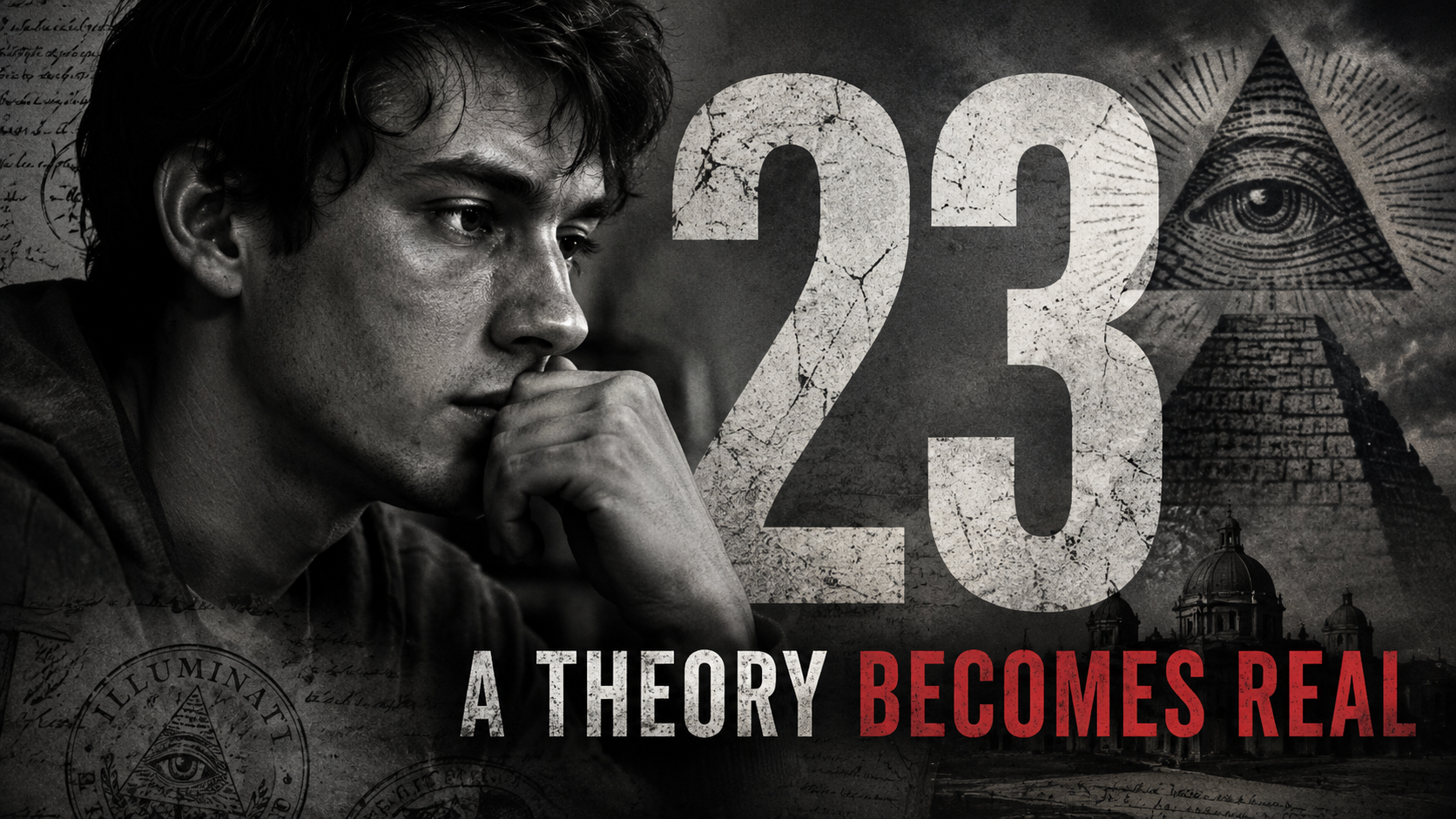
On a hacker who died believing, a secret society that lasted nine years, and the question that now runs through millions of minds every day.
On the 23rd of May, 1989, a young German hacker vanished from Hannover.
About a week later, a police officer found his burned body in a forest in the Gifhorn district, the charred remains of a gasoline can beside him. He was 23 years old. And for the last years of his life, he had been convinced that the number 23 was following him — appearing too often, in too many places, to be chance.
His name was Karl Koch. In the hacker underground he called himself Hagbard Celine, after the hero of a novel about the Illuminati. His death was ruled a suicide. It has been doubted ever since.
This is an article about a secret society that was destroyed in 1785 — and about why, more than two hundred years later, it still shapes how millions of people see the world.
The order that actually existed.
Almost nobody knows the strangest fact about the Illuminati: they were real, and they barely lasted a decade.
On the 1st of May, 1776, a law professor named Adam Weishaupt founded a secret society in the Bavarian city of Ingolstadt. He had been educated by the Jesuits, and he despised their grip on knowledge and power. So he did something revealing — he copied the structure of the order he hated in order to fight it. The Illuminati were built on the Jesuit model: ranks, grades, initiation, absolute obedience.
The form gets inherited. Even by its enemies.
Members took code names from antiquity. Weishaupt was Spartacus. To rise through the ranks, a member had to submit a report listing the books he owned, naming his enemies, and describing the weaknesses of his own character. The order collected the vulnerabilities of its own members — the same information control we documented in our episode on high-control religions, running quietly in 1776.
At its height it had perhaps two to three thousand members. And then it collapsed — not from outside, but from within. Weishaupt feuded with his own deputies. Rumors of subversion reached the Bavarian court. In 1785, the Elector banned the order. Weishaupt fled.
Nine years. That was the lifespan of the most feared secret society in human imagination.
It should have been the end. It was the beginning.
The raid that created a god.
In 1786, Bavarian police raided the home of a senior member and seized the order’s internal papers — ciphers, code names, membership lists, and notes on everything from invisible ink to poisons.
Then the government did something clever and catastrophic. They published it all, as proof of how dangerous the order had been.
Think about what that means. They took the secret documents of a clandestine society and turned them into a public book — a permanent, state-authenticated record saying: this secret society was real, it had hidden plans, and here is the proof.
They meant it as an obituary. The world read it as a manual.
Because once those documents existed in print, the Illuminati could never truly die. Anyone, in any century, could point to them and ask: who says they ever really stopped?
This is the pattern we have seen in every episode of this series. The exposure becomes the evidence. Transparency becomes proof of the conspiracy. The Bavarian government tried to kill the Illuminati by showing everyone what they were — and instead built the altar.
The myth that never stopped feeding.
The spark came with the French Revolution. When the old order of Europe collapsed in blood, frightened people needed an explanation — not chaos, but a hidden hand. Between 1797 and 1798, a French priest named Barruel and a Scottish scientist named Robison independently claimed the Illuminati had survived in secret and orchestrated the Revolution.
There was no evidence. The order had vanished from the historical record. But evidence was never the point. They offered the comfort of a villain.
And the myth kept feeding. In the 1930s it fused with antisemitic fantasies of a secret cabal — the same machinery behind the Protocols of the Elders of Zion. The Eye of Providence on the dollar bill, a symbol with no connection to Weishaupt, became „proof.“ And in the 1960s, two American satirists began deliberately planting fake Illuminati stories as a prank — including the Illuminatus! trilogy, which broadcast an obsession with the number 23 to a generation.
They meant it as satire. Some took it as revelation.
One of them was Karl Koch.
The pattern that consumed him.
Koch was brilliant, troubled, and living at a combustible moment. He was among the first hackers on Earth, breaking into distant systems through the early networks. He used cocaine heavily — a drug that accelerates the brain’s pattern-recognition until coincidence feels like design. And he was genuinely entangled with intelligence services: he and his associates really did sell hacked Western data to the KGB.
Three accelerants — new technology, a stimulant that supercharges pattern-recognition, and a world where hidden powers really were maneuvering in the dark. Into that fell the 23. He took his name from the novel’s hero. He stepped inside the story.
The same pattern-recognition that made him a gifted hacker destroyed him. Turned up too high, confirmed by real espionage, it stopped being a tool and became a prison.
Whether he took his own life or another took it remains genuinely unresolved. The suicide ruling fits him with terrible precision — the Illuminatus! novels even contain a line about great anarchists dying on the 23rd. But the doubts are real and documented: the remote forest, the barely-scorched ground beneath a severely burned body, his undamaged shoes, and above all his role as the key witness in a coming espionage trial, with both the KGB and his former associates motivated to silence him. More than thirty years later, the autopsy report is still sealed.
For those who believe he was murdered, that silence is proof. But there is a simpler explanation — the autopsy of a body burned that badly protects no one by being public. And so even at the end, the story hands us the same choice it forces on us throughout: to read a withheld document as a hidden hand, or as something ordinary and human.
Karl Koch could never make that choice. That was his tragedy.
The pattern without the drug.
Here is the part that should keep you awake.
The architecture Koch built inside his own head with drugs and isolation — the endless connections, the signal in every coincidence, the certainty of a hidden hand — that architecture is now built for you. By algorithms. By feeds engineered to show you the next link, and the next. By communities that confirm every suspicion the moment you voice it.
QAnon believes today what Koch believed — that a secret cabal controls the world, that only the awakened can see the pattern. And they believe it stone-cold sober. The machine supplies what the cocaine once did.
Karl Koch was ahead of his time. He needed a chemical to reach the state the internet now delivers for free, to millions, every day.
They live longer than he did. The pattern doesn’t drive them into a forest. It drives them into estrangement, broken families, a reality so narrow nothing outside it can reach them.
You live longer that way.
But not necessarily better.
This is Conspiracy Explained — a dystopien.de production. Not to debunk. Not to mock. To understand.
Watch the full episode here
Recommended reading:
René Le Forestier — Les Illuminés de Bavière et la franc-maçonnerie allemande
Robert Anton Wilson & Robert Shea — The Illuminatus! Trilogy
Umberto Eco — Foucault’s Pendulum
This article discusses suicide and addiction. If you’re struggling, help is available at findahelpline.com or befrienders.org. You are not alone.
Sources:
René Le Forestier, Les Illuminés de Bavière
National Geographic and HISTORY.com on the seized Illuminati documents; Barruel and Robison (1797–98)
the Sky documentary 23 – Der mysteriöse Tod eines Hackers (2023) – Die Zeit
Der Spiegel and Die Welt on the Koch case
Chaos Computer Club records oder Hagbard Celine