The Rosicrucians – on a tomb that was never dug, a founder who never lived, and the strangest reversal in the history of secret societies: a myth that became real because enough people wished it were.
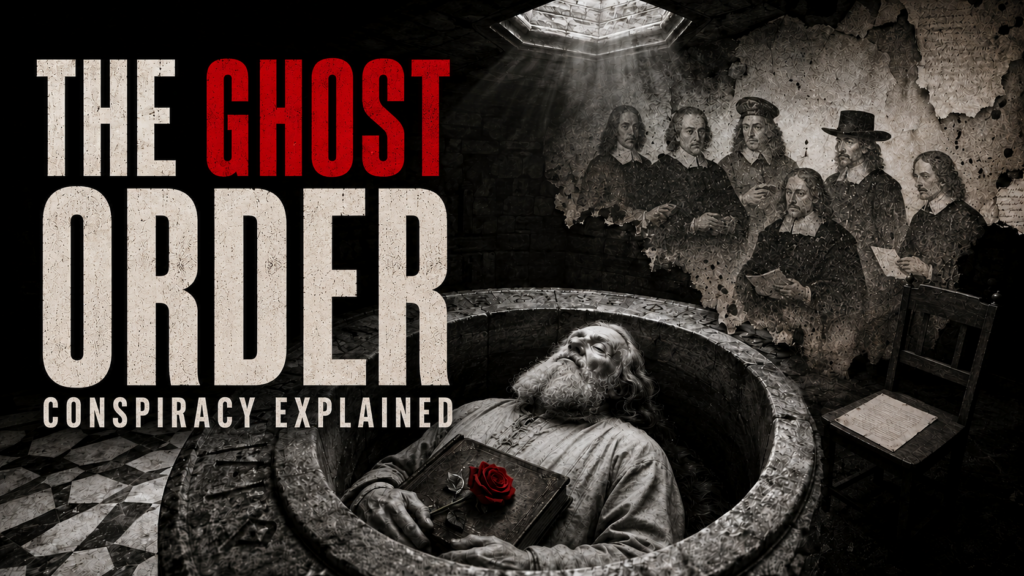
In the year 1604, in Germany, a group of men opened a tomb that had been sealed for a hundred and twenty years.
They had found a hidden door, and on it an inscription: „After 120 years, I shall open.“
Behind it lay a vault with seven sides, each wall five feet wide. No window, no torch — yet the chamber was full of light, from an artificial sun set into the ceiling. The walls were covered in symbols. On the floor and ceiling, a map of the entire universe. In the center stood a circular altar, and beneath it lay a body: a man dead for over a century, whole and uncorrupted, as though he had died that morning. In his hands, a book.
His name was Christian Rosenkreuz.
There is only one problem. The tomb never existed. The body never existed. The man never existed. And the secret brotherhood that supposedly opened the vault never existed either.
This is the strangest story we tell on this channel — because it is not the story of a real thing that became a myth. It is the story of a myth that became a real thing.
The ghost texts.
Between 1614 and 1616, three documents appeared anonymously in the German lands: the Fama Fraternitatis, the Confessio Fraternitatis, and a symbolic novel called the Chymical Wedding of Christian Rosenkreuz.
They told a story. A German nobleman named Christian Rosenkreuz, born in 1378, had traveled to the East, learned the hidden wisdom of the universe from Arab and Persian sages, and returned to found a secret brotherhood — the Fraternity of the Rose Cross. Its members healed the sick for free, gathered in secret, and passed their knowledge down through the centuries, invisible, recognizing one another by hidden signs. Now, the manifestos announced, the brotherhood was ready to reveal itself — and it called on the great minds of Europe to make contact and join.
The effect was extraordinary. The manifestos spread like fire. Hundreds of serious, brilliant people — scientists, physicians, philosophers — read them and were electrified. They wrote open letters begging the brothers to contact them. They professed their worthiness. Some claimed they could already feel the brotherhood watching them.
And the brotherhood never answered. Not once. No reply ever came, no brother ever appeared, no door ever opened — because there was no one on the other side. There never had been.
The men in Tübingen.
The scholarly consensus points to a small circle of young Lutheran intellectuals in the university town of Tübingen — at its center a theology student named Johann Valentin Andreae, with friends like the apocalyptic thinker Tobias Hess and the law professor Christoph Besold, whose esoteric library supplied the raw material.
These were not con men. They were idealists living in a dangerous moment — the years just before the Thirty Years‘ War — dreaming of a great renewal of knowledge and faith, and expressing that dream through literary experiment.
Later in life, Andreae looked back on the Chymical Wedding and called it a ludibrium — a game, a jest, a playful fiction. He described his part in it as a kind of youthful intellectual joke.
Historians genuinely argue about how far to trust that word. Some think the confession was sincere: it really was always fiction. Others think Andreae distanced himself because, as an ordained priest, he could not afford to be linked to something that had spun so wildly out of control. This is one of those threads that does not fully untangle, and honesty means saying so.
But on the central point, four centuries of searching have never wavered. There was no historical Christian Rosenkreuz. No medieval brotherhood. No membership list, no correspondence, no tomb. The order in the manifestos was a ghost — written into being by a handful of young men with a dream and a library.
The ghost that grew a body.
In our last article, we met Léo Taxil, who invented a Satanic cult inside Freemasonry — ghost texts, a ghost witness, a phantom conspiracy — to slander a real organization. The Rosicrucians are the exact inversion. With Taxil, the ghosts wrapped around a real body. With the Rosicrucians, the ghosts came first, and there was no body at all.
And then the strangest thing in this entire series happened. The ghost grew a body.
Because the manifestos did not just describe a brotherhood — they called for one. And enough people wanted that brotherhood to be real that they simply began to act as if it were. They formed networks. They corresponded. They exchanged alchemical and medical knowledge. They started to behave like the invisible college the Fama had described — not because they had found it, but because they had read about it and decided to become it.
The fiction generated the reality. Over the following centuries, that diffuse movement hardened into actual orders — real Rosicrucian societies, with real members and rituals, some of which exist today. They fed into Freemasonry, where the eighteenth degree of the Scottish Rite is called the Rose Croix. They fed into the Hermetic Order of the Golden Dawn, into Theosophy, into nearly the whole architecture of modern Western esotericism.
Every one of them traces back to a tomb that was never dug, holding a body that never breathed, opened by a brotherhood that was never there.
Why the ghost was so convincing.
Part of the answer is the mechanism we see everywhere. The brotherhood was invisible — and invisibility cannot be disproven. If you never find the brothers, that is not evidence they don’t exist; it is proof of how well they hide. Silence becomes confirmation. We saw it with the Illuminati, growing more powerful the less anyone could find them. Here it is at the root: a brotherhood defined by the fact that you cannot see it. The perfect belief, because nothing can ever puncture it.
But there is something more human here too. The people who reached for the Rosicrucians were not fools. They lived in a broken, violent, frightening time, and they were desperate for what the manifestos promised — that hidden wisdom existed, that the world could be healed, that somewhere a company of good and enlightened people was working in secret to make everything better.
That is a beautiful thing to want. And it was exactly the wanting that the ghost fed on. The brotherhood was so attractive that people did not merely believe in it — they built it, until the thing written as fiction stood up and walked around wearing their faces.
The arrow reversed.
Every other story we tell is about a lie wrapped around something real. The Rosicrucians are the pure case. There was nothing underneath — just words on a page, describing a brotherhood that had never met, founded by a man who had never lived, buried in a tomb that was never sealed because it was never dug.
And it became real anyway. Not because it was true, but because it was wanted.
We usually think belief follows reality — first a thing exists, then people believe in it. The Rosicrucians show the arrow can point the other way. Sometimes the belief comes first, and the reality assembles itself afterward, built by the hands of the people who needed it to be there.
A story does not have to be true to change the world. It only has to be believed by enough people who wish it were. Give a ghost enough devotion, and it will grow a body.
And once it has one, you can no longer tell it apart from the living.
This is Conspiracy Explained — a dystopien.de production. Not to debunk. Not to mock. To understand.
Watch the full episode here
Recommended reading:
Frances Yates — The Rosicrucian Enlightenment
Tobias Churton — The Invisible History of the Rosicrucians
Joscelyn Godwin (trans.) — Rosicrucian Trilogy
Some links above are affiliate links. If you buy through them, I may earn a small commission at no extra cost to you. As an Amazon Associate I earn from qualifying purchases. It helps support the work.
Further sources: the Fama Fraternitatis (1614), Confessio Fraternitatis (1615), and Andreae’s Chymical Wedding (1616); Frances Yates, The Rosicrucian Enlightenment; Tobias Churton, The Invisible History of the Rosicrucians.