On Léo Taxil, the twelve-year hoax that fooled a Pope, and why a lie can outlive the confession of the man who told it.
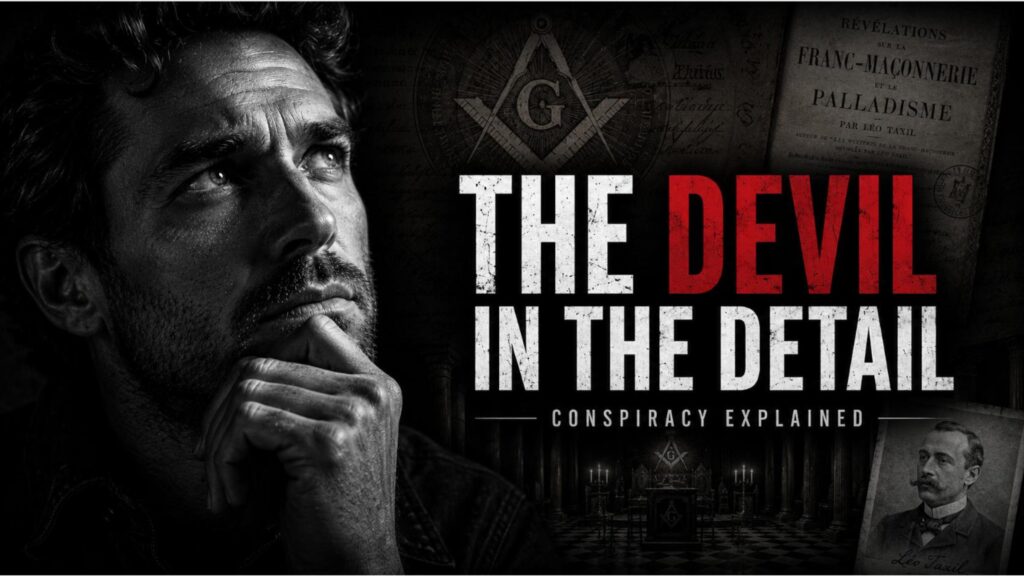
The single most famous claim ever made about the Freemasons (that they secretly worship Satan) did not come from a leak. It did not come from an insider. It did not come from evidence.
It came from one man. He made it up. He admitted he made it up. He stood in a packed hall in Paris in 1897 and explained, in detail, exactly how and why he had invented all of it.
And more than a hundred years later, millions of people still believe him.
This is the story of Léo Taxil. And it is the story of why the truth almost never catches the lie.
One thread in an endless web.
If you try to map the world of secret societies, you will lose your mind before you finish. The Freemasons connect to the Illuminati. The Illuminati borrow from the Jesuits. The Templars bleed into the Rosicrucians, and somewhere in the fog every one of them gets tied to the bankers, the Vatican, and a pizza restaurant in Washington.
It is a single tangled web with no clean edges. So we won’t try to explain the Freemasons here. Nobody can, in one article. What we can do is pull on one thread and follow it all the way down.
Today, the thread of the Devil.
What the Freemasons actually are.
To understand the lie, you need just enough of the truth to measure it against.
Freemasonry grew out of the medieval guilds of stonemasons: the craftsmen who built Europe’s cathedrals and guarded the secrets of their trade. As cathedral-building declined, the lodges began admitting men who were not working masons: gentlemen, thinkers, men of the Enlightenment. The tools of the trade (the square, the compass) became symbols for building a better self and a better society. In 1717, four London lodges formed the first Grand Lodge, the moment modern Freemasonry is usually said to begin.
What it actually was, and largely still is: a fraternal order built on self-improvement, charity, and brotherhood across religious and class lines. In a Europe torn apart by sectarian hatred, a Catholic and a Protestant sitting as equals in the same lodge was genuinely radical.
They have rituals. They have secrets. Mostly passwords, handshakes, and ceremonial forms. What they do not have, and what no evidence has ever shown they have, is an altar to Satan.
But secrecy invites suspicion. In 1738, Pope Clement XII condemned Freemasonry and forbade Catholics from joining. The Church already feared and hated the lodges. All that was missing was proof of something monstrous.
In the 1890s, a man arrived to supply it.
The man who sold the Devil.
His real name was Gabriel Jogand-Pagès. The world would know him as Léo Taxil.
Born in Marseille in 1854 and raised devoutly Catholic, he grew to despise the Church. He became an anticlerical journalist and professional provocateur, writing blasphemous attacks on religion, getting sued and prosecuted for his trouble. And then, around 1885, he did something extraordinary. He publicly, tearfully converted — renouncing his past and pledging to serve the Church he had spent his life attacking.
The Church was overjoyed. Its most notorious enemy had come home. And Taxil announced he would now turn his talents against the true enemy of God: the Freemasons.
What followed was one of the most elaborate hoaxes in modern history. Taxil revealed a hidden inner order within Freemasonry — a secret cult at its highest levels, invisible even to most Masons. He called it Palladism, and claimed its members were Luciferians who worshipped Satan directly, performed black rituals, and were led from Charleston by a real, prominent American Freemason named Albert Pike, whom Taxil crowned the secret Luciferian pope of world Masonry.
None of it was real. But Taxil was a genius of detail. He filled his pages with rituals, hierarchies, and eyewitness scenes of devilry supplied by an invented informant. The more specific the lie, the more true it feels.
The woman who never existed.
Then Taxil gave the story a heroine: Diana Vaughan, a supposed former high priestess of Palladism who had renounced Satan, fled the cult, returned to the Church and would now testify to everything she had seen.
Her serialized memoirs were a sensation. Catholic readers devoured them, clergy praised them, and Taxil’s anti-Masonic work won him an audience with Pope Leo XIII himself, whose own 1884 encyclical against Freemasonry had helped create the very atmosphere in which the hoax could flourish. The most powerful religious institution on Earth was, in effect, endorsing the confessions of a woman who did not exist.
Because Diana Vaughan was invented. For her public moments, Taxil had hired a typist and paid her to impersonate the character. For twelve years, he held the Catholic world in the palm of his hand with a Satanic cult that existed only in his imagination.
But people wanted to see Diana. The doubts grew loud. So Taxil announced she would appear in person: a public lecture, Paris, 19 April 1897.
The confession.
The hall was packed. Taxil took the stage alone. And he told them the truth.
There was no Diana Vaughan. No Palladism. No Luciferian cult, no demons, no Albert Pike as Devil-pope. He had invented all of it and sustained it for twelve years — for one purpose: to humiliate the Church, to hold up a mirror and show how its own intolerance and credulity would lead it to believe anything, however absurd, so long as it confirmed what it already wanted to believe. He had fed the Church its own hatred of the Freemasons, and it had swallowed the whole thing, all the way to the Vatican.
The reaction was chaos: laughter, shouting, fury. Taxil left under police protection. Six days later his full confession was printed in a Paris newspaper. The lie was dead.
Except it wasn’t.
Why the lie outlived the truth.
Here is the part that should stop you cold. Taxil did everything a debunking is supposed to require. He didn’t just get exposed — he exposed himself. He confessed in public, explained his methods, named his invented characters, and published the whole thing in the press. There has rarely been a more complete, more voluntary, more thoroughly documented destruction of a conspiracy theory in history.
And it did not matter.
To this day, if you search for proof that Freemasons worship the Devil, you will find Albert Pike quoted as their Luciferian high priest — a claim that traces directly back to Taxil’s invention. A hoax its own creator demolished in 1897 is still being cited as fact by people who have never heard his name.
Why does the confession never catch up to the lie? Because a lie and its correction do not travel the same way. The lie is thrilling — it has demons, secret temples, a Devil-pope. It confirms what people already fear and gives a shapeless anxiety a face. The correction is boring: a Frenchman explaining a prank, asking you to give up the demons and accept that the truth is a charity organization with funny handshakes. The exciting lie races around the world; the dull correction limps behind, and most people never hear it.
Taxil built a Devil so satisfying that it no longer needed him (or the truth) to survive.
This is the deepest pattern we study. We saw it with the Illuminati, whose own seized documents became their immortality. We saw it with the Protocols of the Elders of Zion, exposed as a forgery and believed anyway. Here it is in its purest form: a man confessing, in full, that he made it up and the lie simply walking past him and carrying on.
A lie does not die when it is disproven. It dies only when people stop finding it useful. And satisfaction, not evidence, is what keeps a conspiracy alive.
The devil, as always, is in the detail. And so is the truth. The trouble is telling them apart — especially when the detail is exactly what you already wanted to believe.
This is Conspiracy Explained — a dystopien.de production. Not to debunk. Not to mock. To understand.
Watch the full episode here
Recommended reading:
Christopher Hodapp — Freemasons for Dummies
Umberto Eco — Foucault’s Pendulum
S. Brent Morris — The Complete Idiot’s Guide to Freemasonry
Sources: Léo Taxil’s confession, Le Frondeur, 25 April 1897
the S. Brent Morris translation for the Scottish Rite Research Society
The Square Magazine (2024)
Papal encyclicals In Eminenti (1738)
Humanum Genus (1884)
Standard histories of the 1717 London Grand Lodge