On the real destruction of the Templars, the dying curse of their Grand Master, and why the superstition we blame on them is six hundred years too young.
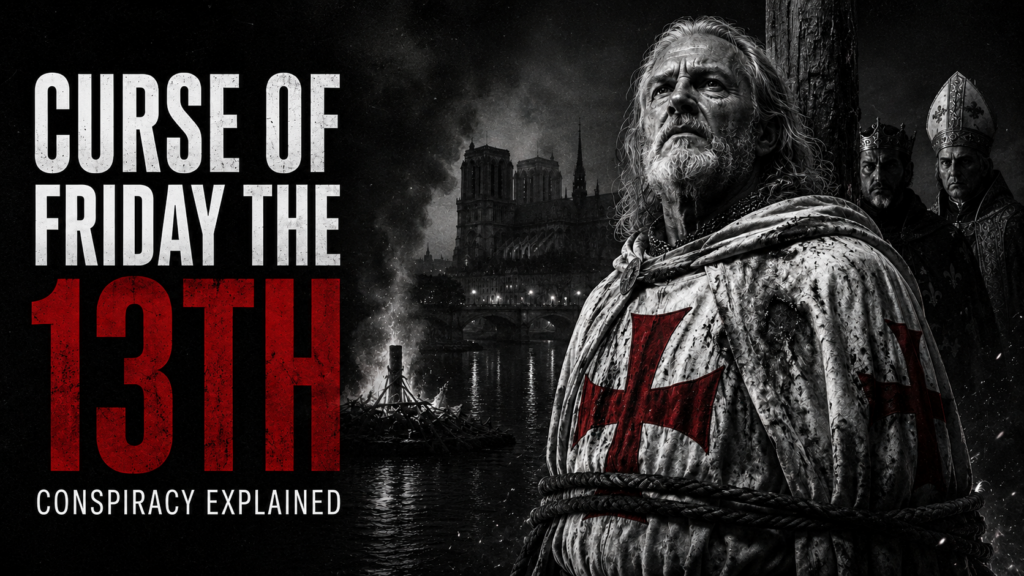
Why are we afraid of Friday the 13th?
Millions of people are. Buildings skip the thirteenth floor. People avoid flying, signing contracts, marrying on that day. And if you ask where the fear comes from, you will hear, again and again, the same answer: that it goes back to a single Friday the 13th, seven hundred years ago, when the most powerful secret order in Europe was destroyed in one morning: the Knights Templar.
It is a great story. It appears in bestselling novels, documentaries, a thousand videos. And it is almost certainly not true.
The arrest happened, genuinely, on Friday the 13th of October, 1307. But the idea that this event gave birth to our fear of the date is a modern invention, barely a century old, stitched onto the Templars long after the fact. This is two stories at once: how the Templars really fell, and how we came to misremember their death.
The richest monks in the world.
The Templars were founded around 1119 to protect Christian pilgrims to the Holy Land. A small band of warrior monks sworn to poverty. That humble beginning did not last. Over two centuries they became one of the most powerful institutions in the medieval world, showered with land and privileges, answering to no king and no bishop, only to the Pope.
And they became bankers. A pilgrim could deposit money at a Templar house in Europe, receive a coded note, and withdraw it in the Holy Land, one of the earliest systems of international banking in the West. The Templars financed wars and held the treasure of kings, including the crown of France.
By the early 1300s they were a state within a state. They were wealthy, armed, secretive, and suddenly vulnerable: the crusader states had fallen, their original mission was gone, and they owed nothing to a king who owed them a great deal. His name was Philip the Fourth. History calls him Philip the Fair. For his looks, not his conduct.
The morning of the 13th.
Philip was broke. He had already emptied other pockets to fund his wars, and he looked at the Templars‘ wealth, secrecy, and independence and saw both a threat and an opportunity.
In total secrecy, he prepared one of the most remarkable operations of the medieval age. Sealed orders went out across France, not to be opened until a set moment. At dawn on Friday, the 13th of October, 1307, they were opened and executed simultaneously across the kingdom. In a single coordinated strike, virtually every Templar in France was arrested. Hundreds of men, including the Grand Master, an old man of around seventy named Jacques de Molay, who the day before had been an honored pallbearer at a royal funeral.
The charges were monstrous and followed an old script used against earlier victims like the Cathars: denying Christ, spitting on the cross, obscene kisses, ritual sodomy, and worshipping a mysterious idol: a head some confessions called Baphomet. They were, almost certainly, fabricated: built from older templates of heresy and designed to justify seizing everything the Templars owned.
Confession, recantation, fire.
Then came the torture. And torture does what it always does. It does not produce truth; it produces whatever the torturer wants to hear. Man after man confessed, even de Molay.
But when some were brought before the Pope’s representatives, away from the king’s men, they recanted, declaring their confessions false and the order innocent. Philip’s answer was fire. In 1310, fifty-four Templars who had retracted were burned alive outside Paris. The message worked: many still in prison hastily reaffirmed their forced confessions.
Pope Clement the Fifth (a Frenchman who owed his position to Philip) resisted, delayed, and gave way. In 1312 he dissolved the order, not on a verdict of proven guilt, but to prevent further scandal. The order was simply abolished, its reputation too damaged to survive.
The curse.
On the 18th of March, 1314, de Molay (now around seventy-seven, after seven years in captivity) was brought before a Paris assembly to hear his sentence of life imprisonment. And the old man, with nothing left to lose, took it all back one final time, declaring publicly that the confessions were lies and the order innocent, and that his only crime was betraying his brothers to save himself.
Under the law this made him a relapsed heretic. The penalty was death, and immediate. That evening he was burned alive over a slow fire on a small island in the Seine, in the shadow of Notre-Dame.
Here history hardens into legend. According to the tradition that grew up afterward, de Molay called out from the flames, summoning both Pope and King to answer before God within the year. Clement died about a month later. Philip died before the year was out. Whether de Molay ever spoke those words we cannot know (the curse appears in later accounts, and legend arranges itself neatly around events) but the deaths were real, and their timing close enough that a haunted Europe drew exactly the conclusion you would expect.
The myth that came later.
Now back to Friday the 13th. Yes, the Templars were arrested on that date. But there is no evidence anyone connected the day to bad luck because of them for centuries afterward. And that is because the two halves of the superstition are far older than the Templars, and long kept separate.
The number thirteen was unlucky on its own: Loki as the uninvited thirteenth guest in Norse myth, whose arrival brings the death of the light-god Balder; Judas as the thirteenth at the Last Supper. Friday was unlucky on its own: the day of the Crucifixion, and in folklore the day of the Fall, of Cain’s murder, of the Flood. Chaucer already warns against starting anything on a Friday.
But welding them into one dreaded unit is astonishingly recent. Folklorists find no real trace of „Friday the 13th“ before the nineteenth century; a popular 1907 novel of that name helped cement it, and the firm references cluster in the early twentieth century — roughly six hundred years after de Molay burned. The fear was assembled from old parts, long after the Templars were gone. Only then did anyone go looking for a dramatic origin. And Dan Brown’s The Da Vinci Code broadcast the Templar link to hundreds of millions in 2003. He didn’t invent it. He simply made a satisfying coincidence feel like a cause.
The arrow, and the ashes.
The Templars were destroyed by a bankrupt king who wanted their money, using fabricated charges and torture, abandoned by a Pope who lacked the courage to protect them. That is not a mysterious story. It is a depressingly ordinary one: greed and power dressed as a holy war. The real conspiracy was never the Templars worshipping a demon head. It was a king and a captive Pope conspiring to murder an order for its treasure.
And then, across the centuries, we did to their memory what Philip did to their bodies. We rebuilt them into whatever we needed: guardians of the Grail, keepers of secret bloodlines, founders of Freemasonry, hidden authors of our unluckiest day. Almost none of it true. All of it more thrilling than the facts.
The date on the calendar is not cursed. But the story is sticky. And a sticky story, as we keep learning, will always outrun the truth.
This is Conspiracy Explained — a dystopien.de production. Not to debunk. Not to mock. To understand.
Watch the full episode here
Recommended reading:
Malcolm Barber — The Trial of the Templars
Dan Jones — The Templars
Barbara Frale — The Templars: The Secret History Revealed
Dan Brown — The Da Vinci Code
Some links above are affiliate links. As an Amazon Associate I earn from qualifying purchases, at no extra cost to you — it helps support the work.
Further sources: Malcolm Barber, The Trial of the Templars; Barbara Frale, The Chinon Parchment; History Today on the 1307 arrest; Steve Roud, The Penguin Guide to the Superstitions of Britain and Ireland.