On the facility in Alaska that controls the weather, triggers earthquakes, and reads your thoughts. And on why none of that is true — but the anxiety behind it absolutely is.
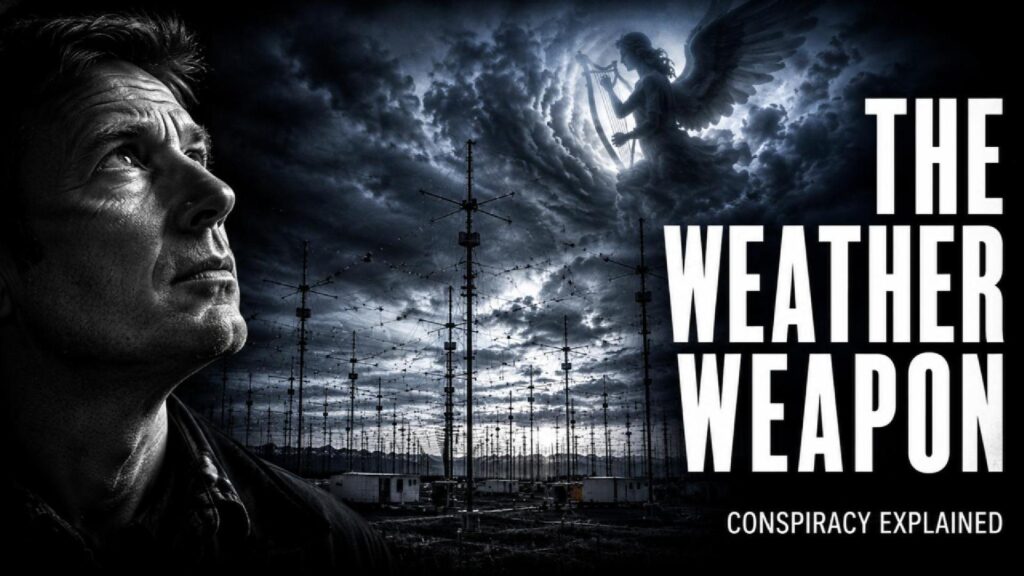
In the remote wilderness of Alaska, approximately 200 miles northeast of Anchorage, there is a field of antennas.
180 of them. Arranged in a precise grid across 33 acres of boreal forest. Connected to transmitters capable of generating 3.6 megawatts of radio frequency energy — enough to heat a small section of the upper atmosphere to temperatures measurable from the ground.
It is called the High-frequency Active Auroral Research Program.
HAARP.
And according to a significant portion of the internet, it is responsible for Hurricane Katrina, the 2010 Haiti earthquake, the 2011 Fukushima tsunami, the disappearance of Malaysia Airlines Flight MH370, mass animal die-offs, global warming, and mind control.
None of that is true.
But here is what is true: HAARP is real. The research is real. The military funded it. The government was not entirely transparent about it. And in 1998, the European Parliament passed a resolution calling for an international ban on it as a weapons system.
This episode is about the gap between what HAARP actually does — and what the human imagination builds inside that gap.
What HAARP actually is.
The High-frequency Active Auroral Research Program was established in 1993 in Gakona, Alaska. It was jointly funded by the US Air Force, the US Navy, DARPA, and the University of Alaska Fairbanks.
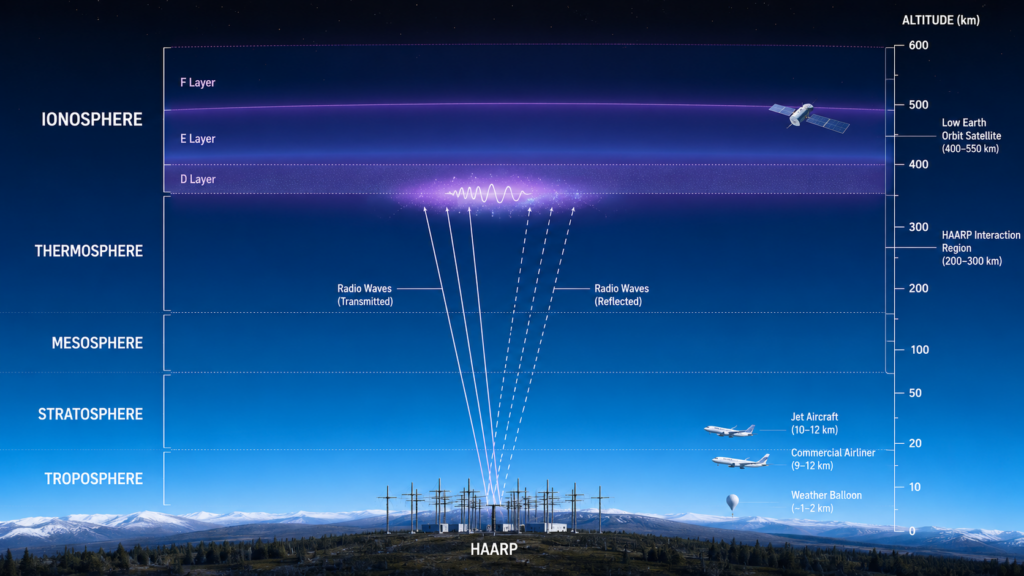
Its purpose — stated and actual, confirmed by decades of published peer-reviewed research — was to study the ionosphere. The uppermost layer of Earth’s atmosphere, approximately 60 to 1,000 kilometers above the surface. Critical for long-distance radio communication, GPS navigation, and understanding space weather.
HAARP studies it by transmitting high-frequency radio waves into the ionosphere and measuring the response. The heating effect this creates is real — but it affects an area roughly the size of a large city, at altitudes where commercial aircraft never fly, for durations measured in minutes.
It cannot control weather.
It cannot trigger earthquakes.
It cannot influence human thought.
The physics don’t allow it.
But physics has never been the point.
Where the theory comes from.
In 1995, two authors named Nick Begich and Jeane Manning published a book called Angels Don’t Play This HAARP. It argued that HAARP was a weapons program disguised as research — that it could be used to disrupt communications, alter weather, and potentially affect human neurological function.
The book was not peer-reviewed. Many of its technical claims were incorrect.
But it established the interpretive framework that millions of people would later apply to every natural disaster, every unexplained event, every anomalous weather pattern.
The framework was simple: HAARP is powerful. HAARP is military. HAARP is not fully transparent. Therefore HAARP could be responsible for anything we cannot otherwise explain.
That logic — powerful plus secretive plus unexplained equals responsible — is the same logic we have seen in every episode of this series.
It is not unique to HAARP. It is the architecture of conspiracy.
The European Parliament resolution.
In 1998, the European Parliament passed a resolution calling for an international convention to ban HAARP as a weapons system.
An official legislative body. A formal resolution.
Not because they had evidence it was a weapons system. But because the concerns had become prominent enough — and the United States government’s explanations had been opaque enough — that elected officials felt they needed to respond.
The resolution went nowhere. But its existence became evidence for conspiracy believers that even governments were taking HAARP seriously as a threat.
This is the paradox that HAARP created — the more official bodies engaged with the claims, even to dismiss them, the more the claims gained legitimacy.
Hugo Chavez and Haiti.
In 2010, after the Haiti earthquake killed over 200,000 people, Venezuelan President Hugo Chavez stated on state television that the earthquake had been caused by a US tectonic weapon — specifically HAARP.
He provided no evidence.
He didn’t need to. The claim spread instantly across social media, across conspiracy forums, across communities that had spent fifteen years building an interpretive framework in which HAARP was already capable of anything.
The accusation confirmed what they already believed.
The 2014 closure.
In 2014, the US Air Force announced it was transferring control of HAARP to the University of Alaska Fairbanks and temporarily shutting down operations.
For the conspiracy community, this was not evidence that HAARP was an ordinary research facility being defunded due to budget constraints.
It was evidence that HAARP had completed its mission — and that the real program was continuing elsewhere, underground, classified, invisible.
The University of Alaska eventually resumed operations in 2015. It hosts open houses. It publishes its research. Scientists from around the world use it.
None of this has significantly changed the conspiracy narrative.
Because the narrative was never really about HAARP.
The transparency paradox.
In recent years, the University of Alaska has hosted multiple public open house events at the HAARP facility. Everything is visible. The equipment is accessible. The researchers answer questions.
Some visitors came specifically because they believed HAARP was a weapons system.
Most left unconvinced that it was innocent.
Not because the evidence was insufficient. Because the evidence was interpreted through a framework in which transparency itself is part of the deception.
The open house was proof that the real HAARP was hidden elsewhere. The published research was the cover story. The friendly scientists were the public face of something darker.
This is what researchers call a non-falsifiable belief — a conviction so constructed that no evidence can challenge it. Every possible response by the institution confirms the theory.
We saw this with the Protocols. We see it here.
HAARP and chemtrails.
In the conspiracy community, HAARP and chemtrails are deeply connected — two halves of the same theory.
Chemtrails seed the atmosphere with conductive particles. HAARP activates those particles using radio frequency energy. Together they form a system of atmospheric control — weather modification, population management, military dominance over the skies.
Neither part of this theory is supported by evidence.
But the connection reveals something important about how conspiracy ecosystems work. Individual theories don’t stay individual. They absorb each other. They connect. They form networks of mutually reinforcing claims in which each theory provides evidence for the others.
This is what researchers call a conspiracy supersystem — a collection of theories so thoroughly interconnected that challenging any one element feels like challenging the entire worldview.
Germany and the anxiety beneath the theory.
HAARP is not only an American concern.
In Germany and across Europe, HAARP became embedded in the same communities that embraced chemtrails, Querdenken, and anti-vaccine movements.
The specific anxiety in the German context is slightly different — less about American military dominance in the abstract, more about the specific memory of being subject to external powers, of technological control imposed from outside, of sovereignty compromised.
In 1986, after Chernobyl sent radioactive clouds across Europe without warning, West German citizens experienced firsthand what it meant to have no control over what entered their air. The state had no answer. Science had no comfort. The damage was invisible, the source was foreign, and the authorities were slow.
HAARP arrived into a culture that already knew, from lived experience, that external forces could poison the air without permission.
In 2013, when unusual flooding devastated large parts of Central Europe, HAARP trended in German online communities within hours. Not as a question. As a conclusion.
The theory is wrong. The memory it speaks to is not.
What it tells us.
The HAARP facility in Alaska is a legitimate scientific research installation. It studies the ionosphere. It publishes its findings. It does not control weather, trigger earthquakes, or influence human thought.
This is not a matter of opinion. It is a matter of physics.
But the feeling that powerful institutions are using invisible technologies without full public accountability — that feeling is not irrational.
Governments have classified research programs. Militaries have developed weapons they don’t announce. Institutions have lied about what they were doing — as we established beyond any doubt when we talked about MKUltra.
The instinct that says something powerful is happening that we are not being told about is sometimes correct.
HAARP is not the example that proves it.
But the instinct is not crazy.
And the question — the question this series returns to every episode — is not how we mock the people who look at a field of antennas in Alaska and see something sinister.
The question is what we build instead.
What institutions transparent enough, accountable enough, honest enough — that the gap between what they do and what they say never becomes wide enough for a weather weapon to grow inside it.
This is Conspiracy Explained. Not to debunk. Not to mock. To understand.
Watch the full episode here
Recommended reading:
Nick Begich & Jeane Manning — Angels Don’t Play This HAARP
Sharon Weinberger — The Imagineers of War
Nick Begich — Controlling the Human Mind
Sources:
University of Alaska Fairbanks HAARP research publications
European Parliament Resolution 1998
CIA declassified ionosphere research documents