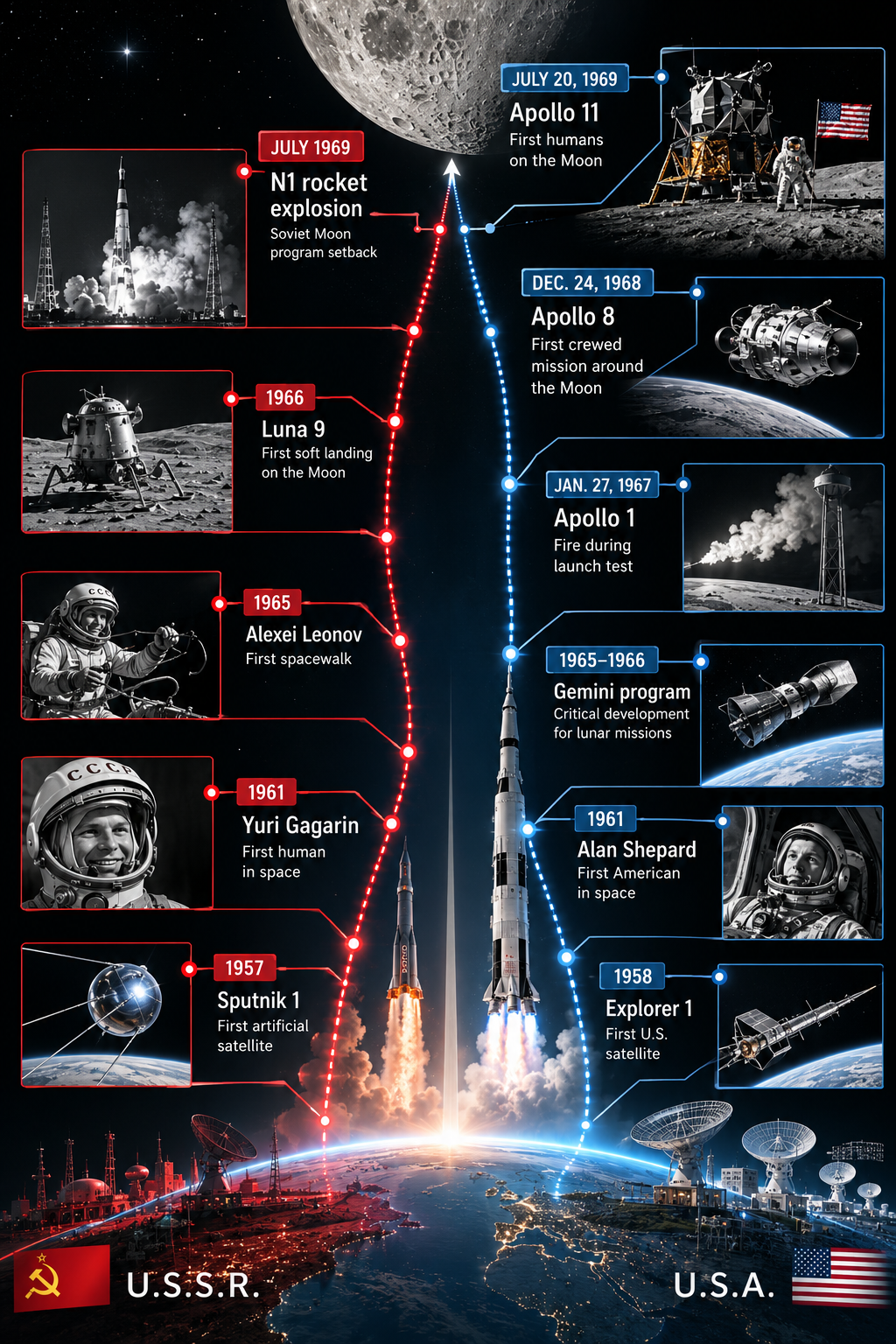
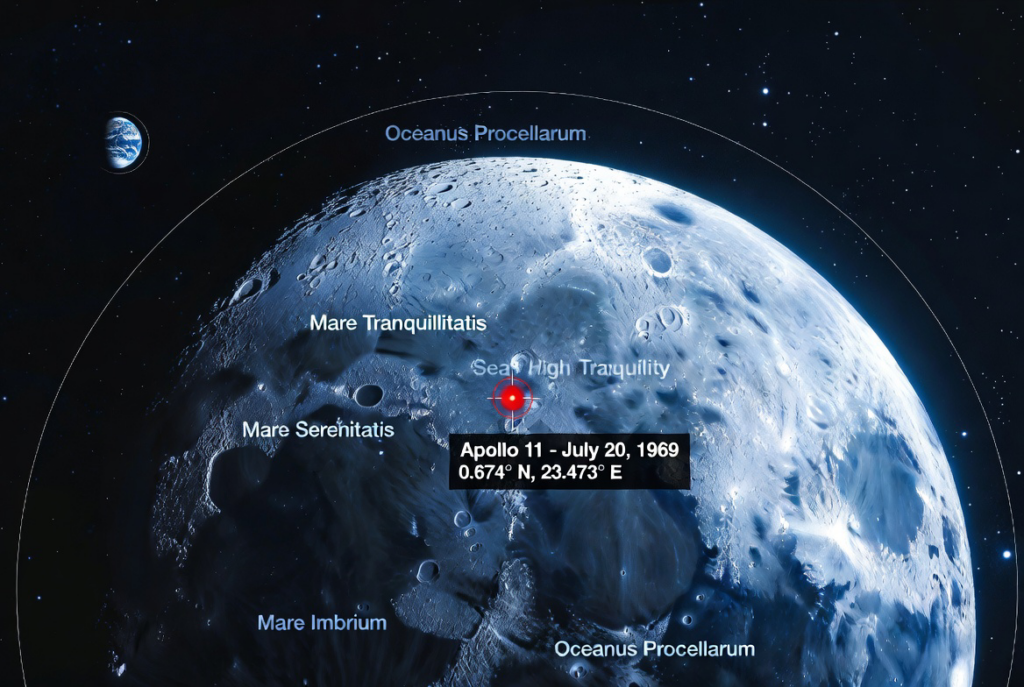
On the most documented event in human history — and why millions still refuse to believe it happened.
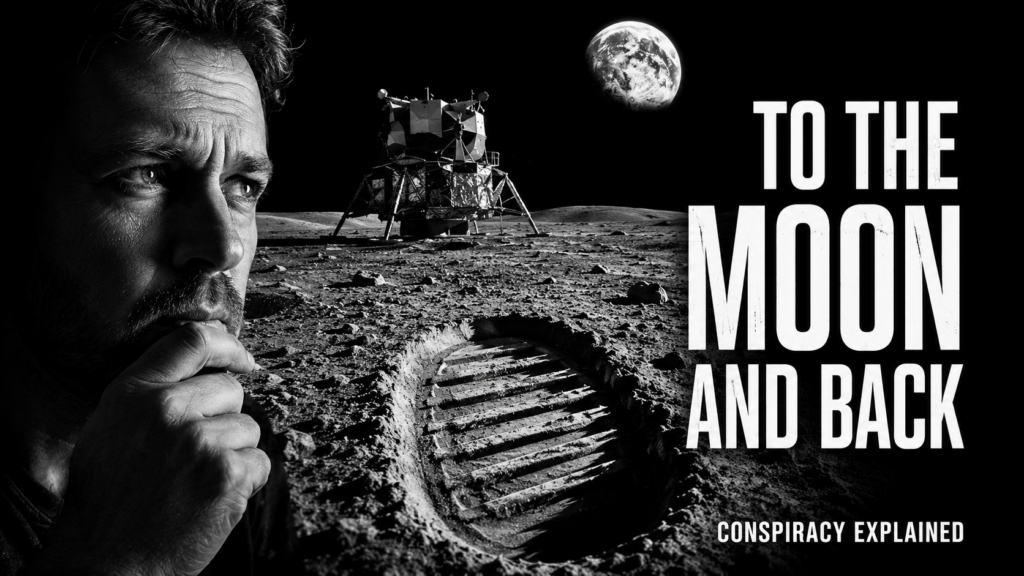
On July 20th, 1969, approximately 650 million people watched a man step onto the surface of the Moon.
It was the most watched television broadcast in human history to that point. A global audience, united for a single moment, watching Neil Armstrong descend a ladder and speak words that would be quoted for centuries.
It was real.
And almost immediately, some people began to suspect that it wasn’t.
Today, depending on the survey, somewhere between 5 and 20 percent of people believe the Moon landing was faked. Among younger people — raised on a diet of digital manipulation, deepfakes, and institutional distrust — the number is growing.
This is not an article about whether the Moon landing happened. It happened.
This is an article about why, more than fifty years later, millions still don’t believe it — and what that disbelief reveals about truth, evidence, and trust.
The conspiracy version.
Let’s start with the conspiracy version. Because it’s a good story.
The United States could not actually land humans on the Moon before the Soviet Union, the theory goes. The technology wasn’t ready. But the political stakes — the Cold War, national prestige, a promise made by a now-dead president — made failure unacceptable.
So instead of landing on the Moon, NASA filmed it. On a soundstage. With Hollywood techniques. Possibly directed by Stanley Kubrick, whose 2001: A Space Odyssey had demonstrated, just one year earlier, that convincing space imagery could be created on Earth.
It has a motive. It has a method. It has a famous name attached. And it has the irresistible appeal of the hidden truth that only the awakened few can see.
There’s just one problem.
It would have been harder to fake than to actually do.
The Kubrick paradox.
In 1969, the special effects technology required to convincingly fake the Moon landing — the lighting, the physics of dust in a vacuum, the behavior of objects in one-sixth gravity, continuous live television transmission from lunar orbit — did not exist.
Stanley Kubrick is the proof of this.
2001: A Space Odyssey is a masterpiece. But watch it today and you can tell it was filmed on Earth. The physics are subtly wrong. The dust doesn’t behave correctly. The motion is earthbound.
To fake the Moon landing convincingly, NASA would have needed to invent special effects technology decades ahead of its time — and then keep it secret while Hollywood continued using visibly inferior techniques for another thirty years.
The faking would have required more advanced technology than the landing itself.
What you can check yourself.
Here is the part the conspiracy tends to leave out.
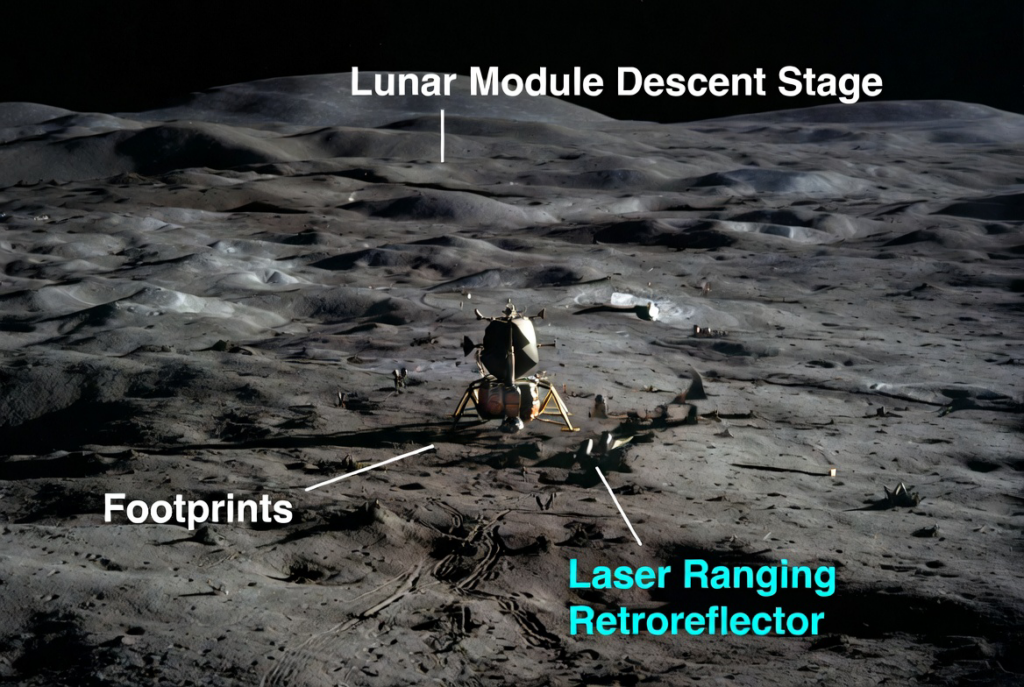
During the Apollo missions, astronauts placed devices on the lunar surface called retroreflectors — special mirrors designed to bounce laser beams directly back to their source.
These reflectors are still there.
To this day, observatories around the world — the McDonald Observatory in Texas, the Côte d’Azur Observatory in France, the Apache Point Observatory in New Mexico — fire lasers at the Moon and measure the reflection. Universities with no connection to NASA.
Anyone with the right equipment can verify that there are human-made reflectors on the surface of the Moon, placed precisely where NASA said they landed.
This isn’t NASA asking you to trust them. This is independent, repeatable, physical evidence.
And the Soviet Union — America’s direct competitor, with every motivation to expose a hoax and the technical capacity to detect one — tracked the Apollo missions independently. They never disputed the landing.
If the Moon landing had been faked, the one nation most motivated to prove it, and most capable of proving it, would have done so immediately.
They didn’t. Because they couldn’t. Because it was real.
Where the theory comes from.
In 1976, a man named Bill Kaysing self-published a book called We Never Went to the Moon: America’s Thirty Billion Dollar Swindle.
Kaysing had worked for Rocketdyne, a company involved in the Apollo program — though in a clerical and technical writing capacity, not as an engineer. He had no expertise in the relevant fields. But he had proximity, and proximity gave his claims an air of insider authority.
His book introduced nearly all the arguments that would define the Moon hoax theory for the next fifty years.
The flag appears to wave — in a place with no air. The shadows fall in different directions. There are no stars in the photographs. The radiation of the Van Allen belts should have killed the astronauts.
Every one of these arguments has a clear scientific explanation.
The flag waved because it was being moved and a horizontal rod held it extended; in a vacuum, the motion continued longer than it would on Earth. The shadows fall differently because of uneven terrain and wide-angle lens distortion. There are no stars because the camera exposures were set for the bright sunlit surface. The radiation exposure during rapid transit through the Van Allen belts was real but not lethal.
These explanations are well documented. But finding them requires something the theory is designed to prevent: trusting the explanation.
Why the theory survives.
The Moon landing hoax theory does not survive because the evidence is ambiguous. The evidence is overwhelming. Hundreds of thousands of people worked on Apollo. Independent nations tracked it. Physical artifacts remain on the lunar surface. Moon rocks have been analyzed by scientists worldwide with no stake in the outcome.
The theory survives for the same reasons every theory in this series survives.
It offers the pleasure of seeing through the official story. It offers membership in a community of the awakened. It offers a simple, dramatic narrative in place of a complex, technical reality.
And it offers a response to a genuine truth: governments do lie.
The same United States government that landed on the Moon also ran MKUltra. Also misled the public about Area 51. Also conducted secret experiments on its own citizens.
So when someone says the government faked the Moon landing, they are wrong about the specific claim — but they are drawing on a pattern of institutional deception that is, in other contexts, completely real.
This is the tragedy of broken trust. When institutions lie about some things, people lose the ability to believe them about anything. Even when they’re telling the truth. Even when they took us to the Moon.
The generational shift.
Belief that the landing was faked is higher among younger generations than older ones — a reversal of the usual pattern, where conspiracy beliefs fade as events recede into established history.
Why?
Because younger people have grown up in a world where images cannot be trusted. Where deepfakes are convincing. Where any video can be manipulated. Where the line between real and fabricated has genuinely, technologically dissolved.
To someone raised in that environment, the question is not why would anyone fake the Moon landing.
The question is how could you possibly know if they did.
This is the post-truth condition we identified in our very first episode — applied retroactively to one of the most well-documented events in human history.
The Moon landing didn’t become more doubtful because new evidence emerged. It became more doubtful because trust in evidence itself eroded.
The reversal.
We end every episode with the same question.
The Moon landing is one of the most thoroughly documented, independently verified, physically confirmed events in human history. The reflectors are still on the Moon. The rocks are still in the laboratories. The Soviet tracking data still exists.
And still — millions doubt.
Not because they are stupid. Not because they are crazy. But because they live in a world where institutions have squandered their credibility, where images can be faked, and where the difference between healthy skepticism and corrosive denial has become almost impossible to navigate.
The Moon landing was real.
The doubt is also real.
And the question is not how we mock the doubters. It’s how we rebuild a world in which the truth, when we finally achieve something extraordinary and true, is something people can actually believe.
Because we did go to the Moon.
And the fact that millions don’t believe it might be the most dystopian thing this series has examined.
Not the lie that people believe.
The truth that they can’t.
This is Conspiracy Explained — a dystopien.de production. Not to debunk. Not to mock. To understand.
Watch the full episode here
The legendary movie by Stanley Kubrick: 2001: Space Odysee
Recommended reading:
Charles Fishman — One Giant Leap
Roger Launius — Apollo’s Legacy
Bill Kaysing — We Never Went to the Moon
Sources:
Lunar Laser Ranging experiment data
List of conspiracies regarding the moon landing
Lunar Laser experiments overview
Bill Kaysing — We Never Went to the Moon (1976) – listed above