On Mormons, Adventists and Jehovah’s Witnesses — and the structural template they share with every modern conspiracy theory. This one is personal.
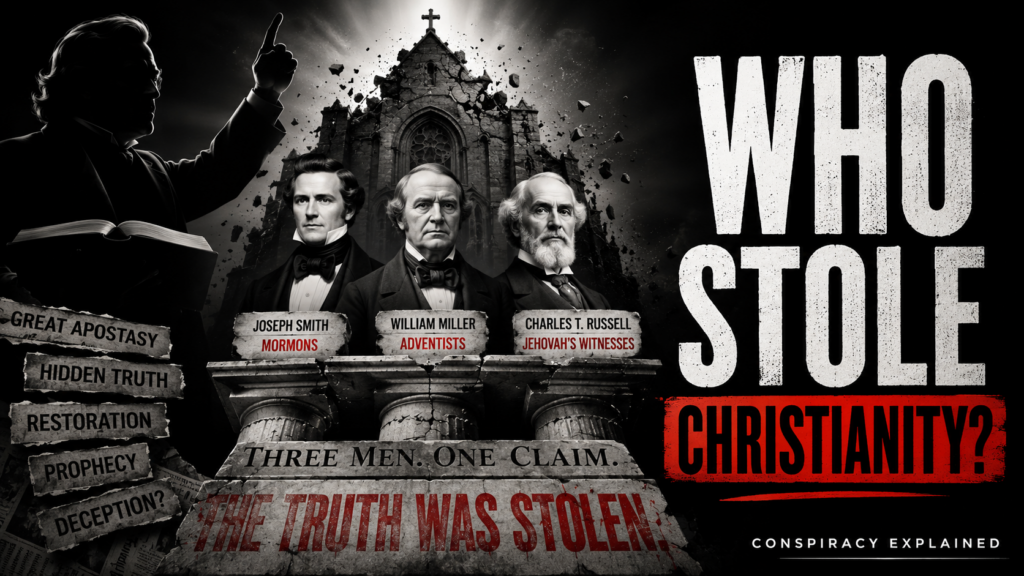
There is a pattern.
Sometimes it is a conspiracy in the truest sense — coordinated, deliberate, decided by a small group of powerful people. Sometimes it is something stranger: a structure that emerges on its own, without anyone designing it.
Either way — a pattern.
We have spent eight episodes of this series identifying that pattern in conspiracy thinking. In Flat Earth. In QAnon. In the Protocols of the Elders of Zion.
This article is different.
It is about three religious movements that most people would never place in the same sentence as conspiracy theories. Three movements with millions of sincere, dedicated, genuinely good people among their members. The Church of Jesus Christ of Latter-day Saints. The Seventh-day Adventist Church. Jehovah’s Witnesses.
This is not an attack on their faith.
It is an examination of their architecture.
Because the architecture — the structural template through which these movements operate — is the same architecture we have been documenting all along.
Why here? Why then?
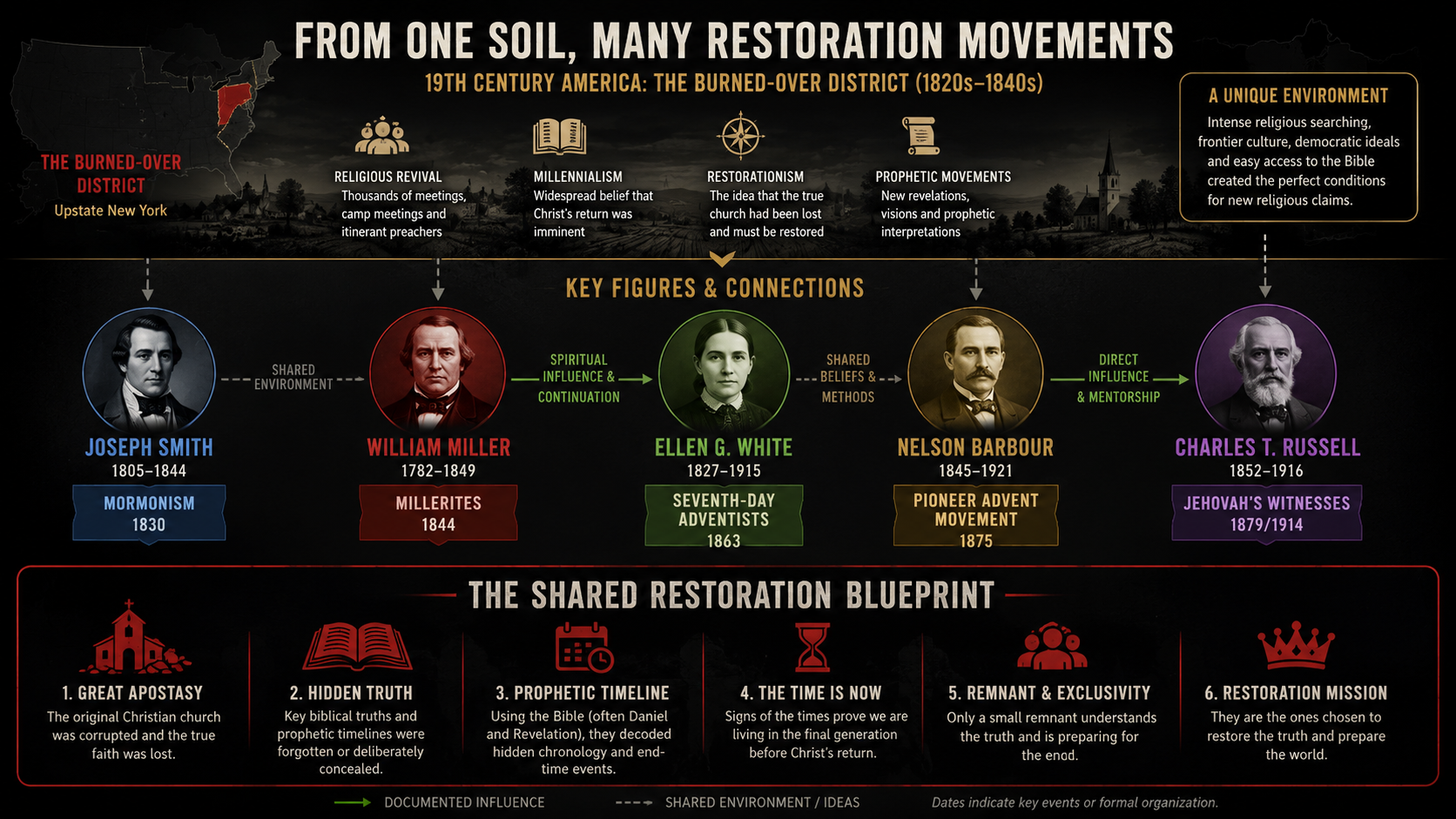
The year is 1820. America is young, the frontier is expanding, and the old European churches have lost much of their authority.
Across upstate New York, thousands gather in fields and tents. Preachers arrive weekly. Prophecies are debated in newspapers. Entire communities argue about the end of the world.
Historians would later name this region the Burned-over District — not because of fire, but because every acre had already been scorched by religious revival.
And when everyone claims to possess the truth, something unusual happens. People stop looking for a church. They start looking for a restoration — a return to something pure that existed before all churches became corrupted.
It is no coincidence that Joseph Smith emerged here. It is no coincidence that William Miller preached here. It is no coincidence that the ideas Charles Taze Russell would inherit were born here.
The environment itself was generating restoration movements. America had become a laboratory for certainty.
The four pillars.
Strip away the theology, and all three movements rest on the same four structural elements.
The first is the Great Apostasy — the claim that the true church was lost for nearly two thousand years and that this specific movement restored it. This is the most radical assertion a religion can make, because it discredits every alternative at once. If every Christian tradition before you is corrupted, then you become the only valid source of truth.
The second is the Exclusive Text — a source of authority that cannot be evaluated from the outside. The Book of Mormon, translated from plates that no longer exist. Ellen White’s writings, accepted as divine on the basis of her own claimed authority. The New World Translation, produced by an anonymous committee and rendering key passages to match predetermined conclusions. Once you accept that your movement’s text is more reliable than all outside scholarship, you have accepted a closed system.
The third is Prophetic Urgency — the end is near, the clock is running, there is no time for doubt. Miller calculated 1844. Russell calculated 1914. When the dates passed, the frameworks were not abandoned. They were reinterpreted. And here the research becomes uncomfortable: failed prophecy, as Leon Festinger documented in 1956, often strengthens belief rather than destroying it. The believer who has sacrificed everything cannot afford to be wrong, so the mind finds a way to preserve the framework.
The fourth is the Control System — what former cult member and researcher Steven Hassan calls the BITE Model: control of Behavior, Information, Thought and Emotion. Diet, dress, time. Warnings against outside information. Doubt reframed as spiritual danger. And shunning — the systematic withdrawal of all social connection from those who leave. Among Jehovah’s Witnesses this is the most comprehensive: parents instructed not to speak to their own children, families divided on instruction. Shunning makes exit catastrophically costly. It is not a side effect of belief. It is a feature.
The borrowed date.
Here is the detail that exposes the whole structure.
Jehovah’s Witnesses present 1914 as a uniquely revealed truth, decoded directly from scripture. It was not. Russell inherited it. The calculation runs from William Miller’s failed 1844 prophecy, through the Adventist Nelson Barbour, who recalculated the date to 1914, to Russell, who adopted it directly. The chronology that anchors the entire movement is not original revelation. It is a hand-me-down — passed from prophet to prophet, recalculated each time the previous deadline expired.
The exclusive truth is, in fact, recycled truth.
And that is the deeper point. These movements present themselves as independent restorations of pure Christianity, each one directly illuminated by God. In reality they are a family tree. They copy from one another, build on one another, inherit dates and ideas. The supposed uniqueness of each movement is, on closer inspection, a line of descent.
Which is exactly how conspiracy theories work. QAnon inherits from the Protocols. The Protocols inherit from older myths. The Illuminati panic inherits from Barruel and Robison. Nobody invents from nothing. Everyone recycles the template and claims to have discovered it first.
Why this matters.
Understanding the template is not an act of disrespect toward people of faith. The vast majority of members of these three movements are sincere, kind, generous people who have found genuine meaning, community and purpose.
This is not about them. It is about the architecture that surrounds them — an architecture that, regardless of whether the theological claims are true or false, functions to limit information, manufacture urgency, create dependency and make leaving psychologically and socially devastating.
Those functions are documented. They are not matters of theological interpretation. They are sociological facts. And they are the same functions that conspiracy ecosystems serve for the people who inhabit them.
The template emerges from something real — the need for certainty in an uncertain world, the need to belong, the need to matter in a story larger than yourself. These are not weak needs. They are among the most human needs that exist. And they are met, genuinely, by these movements — which is precisely why the control around them is so effective. It surrounds something real.
The control system is not separate from the meaning. It is woven through it.
That is what makes it so hard to leave — and so important to understand.
This episode was personal.
I did not come to recognize this pattern by studying QAnon and working backward to religion. I came to it the other way around. I saw the architecture from the inside first — and recognized it everywhere else afterward.
Not to debunk. Not to mock. To understand.
Because the ideas that seem most certain are sometimes the ones most worth examining.
This is Conspiracy Explained — a dystopien.de production.
Watch the full episode here
Recommended reading:
Steven Hassan — Combating Cult Mind Control
Raymond Franz — Crisis of Conscience
M. James Penton — Apocalypse Delayed
Leon Festinger — When Prophecy Fails
Sources: jwfacts.com; Frenken, Bilewicz & Imhoff — Political Psychology (2023); Piraino, Pasi & Asprem — Religious Dimensions of Conspiracy Theories; primary publications of the Watch Tower Society, the Seventh-day Adventist Church, and the Church of Jesus Christ of Latter-day Saints.
Primary Sources
The Book of Mormon — churchofjesuschrist.org
Ellen G. White — The Great Controversy (1888) — egwwritings.org
William Miller — Evidence from Scripture and History of the Second Coming of Christ (1836) — archive.org
Charles Taze Russell — Studies in the Scriptures (1886-1904) — archive.org
New World Translation of the Holy Scriptures — jw.org
Watch Tower Society — Millions Now Living Will Never Die (1920) — archive.org
Watch Tower Society — The Watchtower, January 15, 1983 (independent thinking)
Watch Tower Society — The Watchtower, March 15, 1986 (apostate literature)
Watch Tower Society — The Watchtower, April 15, 1988 (shunning family members)
Watch Tower Society — Awake!, May 22, 1969 (higher education)
Watch Tower Society — Should You Believe in the Trinity? (1989)
Watch Tower Society — Shepherd the Flock of God (elders‘ manual) — leaked copies at jwleaks.org
Academic Sources
Steven Hassan — Combating Cult Mind Control (1988/2018) — BITE Model: freedomofmind.com
Raymond Franz — Crisis of Conscience (1983)
Fawn Brodie — No Man Knows My History (1945)
Richard Bushman — Rough Stone Rolling (2005)
M. James Penton — Apocalypse Delayed (1985)
David Rowe — God’s Strange Work: William Miller and the End of the World (2008)
Terryl Givens — By the Hand of Mormon (2002)
Ronald Numbers — Prophetess of Health (1976)
Walter Rea — The White Lie (1982)
Bruce Metzger — Jehovah’s Witnesses and Jesus Christ (1953)
Jason BeDuhn — Truth in Translation (2003)
Leon Festinger, Henry Riecken, Stanley Schachter — When Prophecy Fails (1956)
Bart Ehrman — How Jesus Became God (2014)
Richard Bauckham — Jesus and the God of Israel (2008)
Frenken, Bilewicz & Imhoff — On the Relation Between Religiosity and the Endorsement of Conspiracy Theories, Political Psychology (2023)
Piraino, Pasi & Asprem (eds.) — Religious Dimensions of Conspiracy Theories: Comparing and Connecting Old and New Trends (Routledge)
Documentary Sources
Shunned (2017)
Escaping Twin Flames (Netflix)
The Vow (HBO) — NXIVM
Image Sources
Library of Congress — loc.gov
Wikimedia Commons — commons.wikimedia.org
National Portrait Gallery
Adventist Media Exchange
Mormon History Association — mormonhistoryassociation.org
Next: The Illuminati — where the search for hidden patterns becomes deadly.